

It should be noted that any abnormalities in the mouth, throat pain, changes in the voice, and swelling of the neck without any reason should be reported to doctors if the patient experiences these problems for a certain period of time. Despite the fact that the listed above symptoms do not show the development of cancer but rather belong to non-cancerous diseases that may occur to any person of any age, it is necessary to take care of them seriously.
Symptoms of Head and Neck Cancer vary depending on the location of the tumor. Patients usually experience persistent ulcers in the mouth, difficulty swallowing, hoarseness, or a neck lump.
Getting to know the symptoms of head and neck cancers, their risk factors, as well as methods used for the diagnosis of these types of cancers will help people to become more conscious and visit specialists who are able to evaluate their condition.
What is Head and Neck Cancer?
Head and neck cancer denotes cancers of the head and neck region. Common locations of head and neck cancers include:
- Mouth: It includes the tongue, lips, gums, inner cheeks, and the floor of the mouth.
- Pharynx: It involves various parts of the throat, including nasopharynx, oropharynx, and hypopharynx.
- Larynx: It is known as the voice box.
- Nasal cavity and sinuses: It denotes the passage inside the nose and surrounding air spaces.
- Salivary glands: It includes glands responsible for producing saliva.
The majority of cancers located in the head and neck area are squamous cell carcinomas (SCC). By squamous cell carcinoma, we understand malignancies that arise from the squamous cells lining the aerodigestive tract.
Together with head and neck cancers, thyroid cancer, which differs from head and neck cancers, belongs to the head and neck cancers.
Types of Head and Neck Cancers
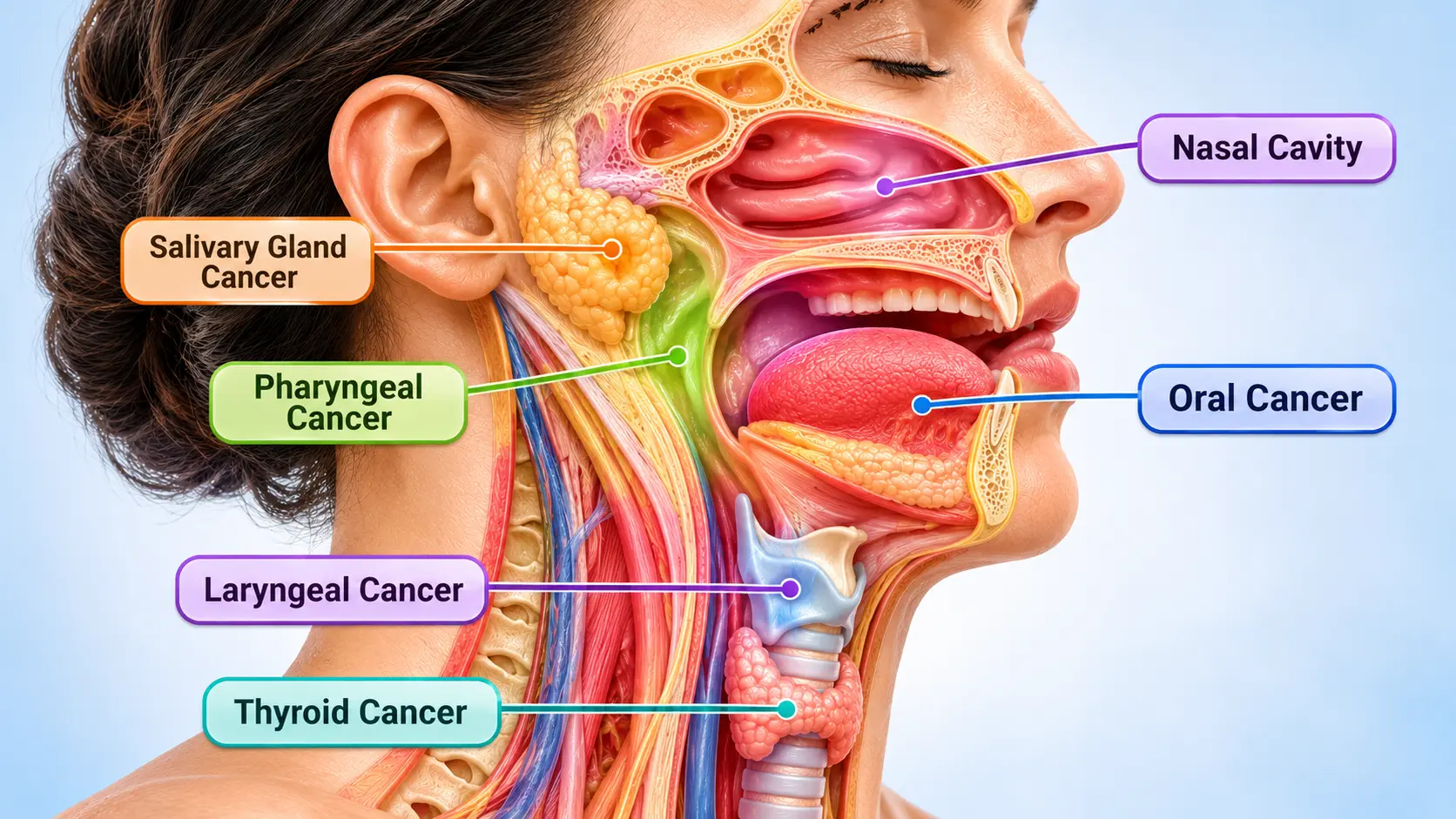
Depending on the specific anatomic location, various types of head and neck cancers are distinguished.
1. Oral Cancer
The cancer of the tongue, gums, lips, inner cheeks, and floor of the mouth. Among the earliest symptoms of the disease, one may notice persistent ulcers, patches, and tissue thickening.
2. Oropharyngeal and Pharyngeal Cancer
It represents the head and neck cancer that affects the tonsils, base of the tongue, and other parts of the pharynx. Oropharyngeal cancer is associated with HPV infection.
3. Laryngeal Cancer
It refers to the cancer of the larynx that leads to the changes in the voice and voice hoarseness.
4. Nasal Cavity and Sinus Cancer
It involves the nasal passages or paranasal sinuses and is characterized by unilateral nasal blockage, nosebleeds, and facial pain.
5. Salivary Gland Cancer
It denotes the cancer of the salivary glands, which manifests as lumps in the cheek, jaw, and behind the ear area.
6. Thyroid Cancer
It means the cancer of the thyroid gland, appearing as a thyroid nodule or neck swelling.
Symptoms of Head and Neck Cancer: What are the Symptoms to Watch out for?
The symptoms of head and neck cancer are related to the exact location in the body. The symptoms can be similar to those seen in different dental, throat, and respiratory disorders.
The general symptoms of head and neck cancer include:
- Unexpected mouth ulcers: Mouth sores without any cause.
- Neck mass: An unexpected swelling might be caused by enlarged lymph nodes in the neck.
- Unexpected red or white patches: Unexpected patches in the mouth may be precancerous lesions.
- Difficulty swallowing: Difficulty or pain in swallowing may happen in throat cancers.
- Unexpected hoarseness: A hoarse voice may be caused by the involvement of the larynx.
- Unexpected sore throat: Persisting sore throat needs examination.
- Unexpected bleeding: Unexpected and recurrent bleeding from the mouth or nose needs examination.
- Difficult opening of the mouth: Inability to open the mouth, called trismus, may occur in some patients with oral cavity cancers.
- Unexpected ear pain: Unexpected ear pain without any ear problem can be caused by throat disease.
- Cheek or jaw swelling: An unexpected lump may suggest abnormality in salivary glands or surrounding tissues.
It is important to note that the symptoms above are not always related to cancer. These symptoms may be caused by infections, dental diseases, and other causes. However, persisting, recurrent, or increasing symptoms need to be examined by a doctor.
When to see a doctor for head and neck cancer
Consultation with an oncologist is indicated in the presence of such symptoms as an ulcer in the mouth that does not heal, a neck swelling of unknown nature, persistent changes in the voice, difficulties in swallowing and recurrent one-sided nasal obstruction.
It is possible to have head and neck cancer even if you are young. It’s worth noting that head and neck cancer is not a disease that only affects the elderly and those who smoke.
Causes of Head and Neck Cancer and Risk Factors

Head and neck cancer develops because of certain changes in the genes that control cell growth and division. There are several factors that may contribute to the development of such abnormalities.
The well-known risk factors for head and neck cancer are:
- Tobacco smoking: Smoking tobacco like cigarettes, bidis, or any other tobacco smoke increases the risk of some head and neck cancers.
- Smokeless tobacco: Chewing tobacco in the form of gutka, khaini, and other tobacco products are associated with increased risk of mouth cancer.
- Areca Nut: Use of betel quid and areca nut increases the risk of mouth cancer.
- Alcohol: Excessive consumption of alcohol increases the risk of cancers of the mouth, pharynx and larynx.
- Human Papillomavirus (HPV): Infection with high-risk HPV, particularly HPV-16, is associated with some oropharyngeal cancers.
- Epstein-Barr virus (EBV): EBV infection is linked to the development of nasopharyngeal carcinoma.
- Occupational exposure: Employment in certain industries that involve exposure to wood dust and some chemicals increases the risk of some head and neck cancers.
Combination of tobacco and alcohol use increases the risk of head and neck cancer more than separate use of one of these substances. Not everyone who has the risk factors develops cancer, and vice versa.
How Head and Neck Cancers Are Diagnosed?
The diagnosis of head and neck cancers includes clinical assessment, investigations, and histopathology. The type of tumor suspected determines the diagnostic tools needed in accordance with the clinical findings.
1. Medical History and Clinical Examination
The clinician examines the symptoms, medical history, and the patient’s exposure to smoking and alcohol. He/She examines the oral cavity, throat, and neck area for any suspicious areas and lymph nodes.
2. Endoscopy
In some cases, a flexible endoscope can be used to examine certain areas that cannot be properly examined during routine oral examination, such as the nasopharynx, pharynx, and larynx.
3. Investigations
Investigations help determine the extent of the disease and to know the size of the tumor and its relationship with other nearby tissues and lymph nodes.
- CT scan: This helps visualize the tumor and other structures in the area.
- MRI scan: This is used especially in case there is a suspicion of deep structures or nerve involvement.
- PET-CT scan: To assess the extent of the disease and distant metastasis when required.
- Ultrasound: Usually done for the evaluation of the thyroid nodules and cervical lymph nodes.
All these investigations may not be required for each patient; they are selected based on the suspected cancer and its clinical findings.
4. Biopsy
Biopsy will be performed in order to diagnose cancer; a tissue sample will be taken from the suspicious area and sent to the pathologist for analysis.
FNAC or core needle biopsy will be done in some neck mass cases.
5. Cancer Staging
After diagnosing the cancer, staging will be determined to find out the extent of the disease using TNM classification:
- T : Tumor size and local spread.
- N : Lymph node involvement.
- M : Presence or absence of distant metastasis.
This will help the multidisciplinary team to plan the appropriate treatment strategy.
Cancers of Head and Neck: Who Needs Screening?
Screening refers to the examination of asymptomatic patients, while diagnostic assessment is performed when a patient presents with symptoms or suspicious findings. Universal screening for all kinds of head and neck cancers is not yet indicated at present. However, people who have certain risk factors like smoking, using areca nut, or drinking alcohol may require an examination of the mouth to detect any suspicious finding in the mucosa. Those people with risk factors should ask a healthcare provider about the examinations that can be helpful.
Any suspicious finding needs to be evaluated clinically, and if needed, the patient should have a biopsy taken. Screenings cannot be substituted for diagnostic tests.
Treatment Modalities for Head and Neck Cancers
The treatment of head and neck cancer depends on the tumour site, stage, type, lymph node status, and the patient’s general health condition.
The treatment strategy usually involves many specialists, including head and neck surgeons, medical oncologists, radiation oncologists, radiologists, and pathologists.
1. Surgery
The surgical intervention includes the excision of the primary tumour with adequate oncological margins. In case the disease is in its advanced stages, the neck dissection is required as well in order to remove the lymph nodes.
The reconstructive surgery might be indicated in some patients to restore the functions that were lost due to the surgery.
2. Robotic surgery
The transoral robotic surgery (TORS) is one of the methods of surgery that can be applied for selected head and neck cancers. This method includes surgery with the help of specially designed equipment through the mouth, providing magnification of the surgical field.
TORS can be offered to carefully selected patients with oropharyngeal cancer depending on the location of the tumour and other oncological factors.
The robotic surgery is not applicable to each patient and cannot be regarded as a superior modality of treatment compared to others.
3. Radiotherapy
Radiotherapy is the method that is based on the use of high-energy radiation for the treatment of cancer. This therapy can be recommended for selected cancers as the first-line therapy, after surgery when additional treatment is necessary, or in combination with chemotherapy.
4. Chemotherapy
This is a type of therapy where anti-cancer drugs are used to eliminate or control cancer cells. This treatment can also be used with radiation therapy in locally advanced cancer and some recurrent and metastatic cancers.
5. Targeted Therapy and Immunotherapy
In targeted therapy, there is targeting of specific molecular targets responsible for the formation of cancer cells, while in immunotherapy there is educating the body on how to recognize the cancer cells and how to fight them.
This therapy is done in selected cases based on the features of the tumor, the stage of the disease, and previous treatments.
6. Reconstruction and Rehabilitation
There are some patients who require reconstruction and rehabilitation after treatment. There can be speech and swallowing therapy, nutritional care, and dental care for the management of functional problems.
Life After Treatment of Head and Neck Cancers
Follow-up is an important aspect in the treatment of cancer patients. The aim of follow-up is to monitor the recovery process of the patient, the chance of recurrence of the cancer, and side effects from the treatment.
Depending on the requirements of the individual patient, the following can be done:
- Clinical examination and investigations on a regular basis.
- Speech and swallowing rehabilitation.
- Nutritional care.
- Dental and oral health care.
- Psychological support.
- Abstinence from tobacco smoking, areca nut chewing, and alcohol abuse.
The recovery process will depend on the type of cancer, treatment, and general condition of the patient.
When Should You Consult a Specialist for Head and Neck Cancers?
If you have mouth ulcers, neck swelling, abnormalities in the mouth, hoarseness of the voice or difficulty swallowing, you should consult a specialist.
At Dr. Snehal Robo Cancer Care, Dr. Snehal Shah specializes in head and neck oncology surgery, which entails oral cavity and throat cancer surgery, and selected robot-assisted surgeries.
Some of the professional qualifications of Dr. Snehal Shah include specialization in Head and Neck Onco Surgery and an MCh in Head and Neck Surgery at Tata Memorial Hospital.
His specializations include head and neck cancer surgery, robotic surgery, thyroid and parathyroid diseases, salivary gland tumors, and skull base surgery.
The patients will get information about oral cavity cancer and throat cancer, as well as robotic surgery services provided by the practice.